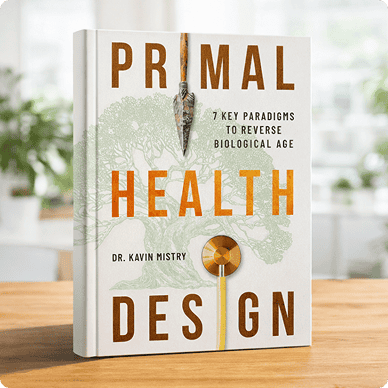
THOUGHT LEADERSHIP
The Neuroscience of Self-Hypnosis: How Attention Rewires Your Brain
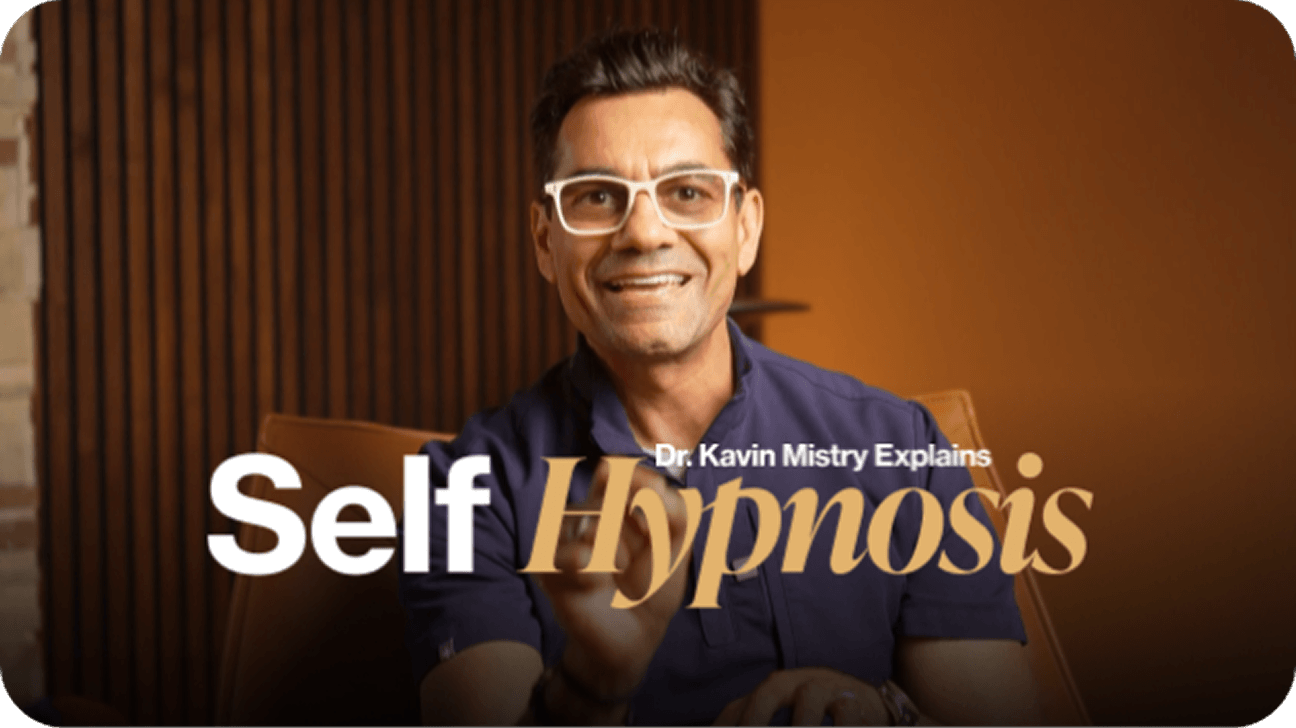
Dr. Kavin Mistry has spent more than 20 years reading brain scans as a neuroradiologist. In this solo short, he breaks down why self-hypnosis isn't about losing control, but reclaiming it: a look at the three brain networks that compete for your attention, why focused states already happen to you every day, and a two-minute guided practice you can follow along with.
highlights
What You'll Learn
- The three brain networks constantly competing for your attention (default mode, central executive, salience)
- Why you already enter hypnotic states daily without realizing it (losing yourself in a novel, missing a highway exit)
- The neuroscience principle behind “neurons that fire together, wire together”
- Why imagined movement recruits many of the same neural networks as actual movement, and what that means for practice
- A two-minute guided self-hypnosis exercise you can follow along with
Attention drives neuroplasticity.
— Dr. Kavin Mistry
Listen on:




Key Takeaways
Self-hypnosis isn't mysticism, it's neurobiology. Your brain already shifts between focused and distracted states every day; this just makes the shift intentional.
1/4
Three networks compete for your attention: the default mode network (inner narrator), the central executive network (focus and problem-solving), and the salience network (decides what deserves attention right now).
2/4
Attention drives neuroplasticity. Whatever you repeatedly focus on literally reshapes your brain, for better or worse.
3/4
Imagined practice primes real performance. Brain imaging shows vividly imagined movement activates many of the same networks as actually doing it, which is why athletes rehearse mentally before competing.
4/4
Related Episode
Cliona O'Hara: Napoleon Hill's Mastermind Method for Building Unshakable Confidence
This clip expands on the hypnosis-for-purpose thread from Cliona O'Hara's episode on self-discipline and the Napoleon Hill Institute.

About
Dr. Kavin Mistry
Dr. Kavin Mistry is a neuroradiologist who has interpreted more than 300,000 brain scans over 20+ years. Primal Shots and his Thought Leadership shorts translate what he's learned about brain structure and function into practical tools for stress, focus, and habit change.
SUBSCRIBE
Aligned Life Newsletter
Aligned Life is Dr. Kavin Mistry's monthly newsletter: rituals, routines, and neuroscience-backed guides for designing a life aligned with how your brain and body are built to thrive.
Transcript
Dr. Kavin Mistry · Thought Leadership
00:00The Neuroscience of Brain States
Imagine if you could change your stress. Change your habits. Change your confidence without changing anything around you. No medication. No expensive technology. No bio hack just by learning how to guide your own brain. That may sound extraordinary, but your brain already does it every single day. As a neuro radiologist, I’ve spent more than 20 years studying the human brain. I’ve interpreted well over 300,000 MRI and CT scans, and those images have taught me something profound.
The brain you see on an MRI tells you about its structure, but the brain that determines your life is its function. It’s the way different brain networks communicate, the way attention is directed, the way emotion shapes perception, the way experience rewires the nervous system. That’s where transformation begins. Today, I want to explain the neuroscience behind self-hypnosis, because I don’t think hypnosis is about losing control.
I think it’s one of the most effective ways of taking control of your own mind. One of the biggest misconceptions about hypnosis is that it’s something someone does to you in reality. Your brain changes states all day long. Think about your smartphone. It has focus mode, sleep mode, low power mode, airplane mode. Your brain has operating modes too. Sometimes your analytical, sometimes your creative, sometimes reactive, sometimes deeply present.
The remarkable thing is that you naturally enter hypnotic states every day when you become absorbed in a great novel, when you miss your highway exit because you’re lost in thought. When an athlete enters the zone, these are all focused brain states. Self-hypnosis simply teaches you to enter that state intentionally instead of accidentally. That’s not mysticism, that’s neurobiology.
02:14The Three Brain Networks
Modern neuroscience tells us that your brain constantly switches between large communication networks. Understanding these may be one of the most important things you will ever learn. The first is the default mode network. Think of it as your inner narrator. It replays yesterday’s mistakes, worries things about tomorrow, and helps create your sense of identity. Left unchecked, it can also create rumination, anxiety, and negative self-talk.
The second is the central executive network. This is the network that allows you to focus, solve problems, learn, and create. It’s your brain’s CEO. The third is perhaps the most fascinating the salience network. Think of it as the brain’s conductor. Every moment it’s asking one question what deserves my attention right now? Because attention is your brain’s most valuable currency.
06:29Attention Drives Neuroplasticity
During self-hypnosis, something remarkable begins to happen. The internal chatter quiets. Focused attention strengthens. Distractions begin to fade. Brain imaging studies suggest these networks communicate differently during hypnosis, creating a state of heightened absorption and reduced self critical thinking, your brain becomes less busy and more teachable. This may be the most important neuroscience principle I can share.
Attention drives neuroplasticity. Whatever repeatedly captures your attention literally reshapes your brain. Every repeated thought strengthens a circuit and we repeat it. Emotion strengthens a circuit. Every repeated behavior strengthens a circuit. That’s why chronic worry becomes easier. But it’s also why confidence becomes easier. The brain doesn’t know whether you’re practicing fear or practicing courage.
It simply strengthens whatever you repeat. Neuroscientists summarize this with one sentence. Neurons that fire together, wire together. Self-hypnosis gives you the opportunity to deliberately choose which circuits deserve strengthening. Olympic athletes have understood this principle for decades, long before competition. They mentally rehearse every moment, every turn, every breath.
Why? Because brain imaging consistently shows that vividly imagined movement recruits many of the same neural networks involved in actual movement. Your nervous system responds not only to experience, but also to meaningful imagination. Imagination doesn’t replace action. It prepares the nervous system for action. Self-hypnosis combines focused attention, emotion, imagery, and repetition.
Those four ingredients create an ideal environment for neural plastic change. As attention narrows. Your breathing naturally slows. The parasympathetic nervous system becomes more active. Heart rate decreases. Muscles relax. The amygdala becomes less reactive. Stress hormones begin to fall and the prefrontal cortex regains control. This is why self-hypnosis fits perfectly within what I call a primal reset.
A primal reset is a return to the way humans were designed to live. For thousands of generations, our nervous system evolved to move fluidly between stress and recovery. Today, many people never leave survival mode. Notifications, emails, deadlines, constant stimulation. The nervous system never fully resets. Self-hypnosis is one way of intentionally returning the brain to a state where learning, healing, creativity, and connection become possible again.
10:29A Guided Self-Hypnosis Exercise
I would like you to experience this for yourself. Let’s sit comfortably. Take one slow breath in through your nose and a longer breath out. Again, slow breath in and the longer breath out. Now pick one point on the wall and let your eyes rest there. Nothing to force, nothing to achieve. Just breathe as you’re breathing slows. Notice your shoulders softening, your jaw relaxing and your thoughts becoming quieter.
Now imagine yourself six months from today. Healthy, calm, focused. Living exactly as the person you want to become. Notice how that version of you walks, breathes, speaks, and serves others? Ask yourself one simple question what would that future version of me do today? Hold that answer. Take one more slow breath and open your eyes.
14:29Closing Reflection
After interpreting more than 300,000 brain scans, I’ve learned that the most meaningful changes rarely begin with anatomy. They begin with function, with attention and the conversations taking place between brain networks long before we ever see structural changes on an MRI. Self-hypnosis is not about surrendering control. It’s about reclaiming it. It’s about learning to direct your attention instead of allowing the modern world to direct it for you.
Because attention is the foundation of every habit, every emotion, every relationship, and ultimately every life. I believe one of the greatest skills of the 21st century won’t be reading faster, thinking harder, or even using AI better. It will be learning how to intentionally regulate your own mind, because when you change your attention, you change your brain. When you change your brain, you change your life.