Lessons from My Keynote at Philly AI Connect Event
Key Takeaways
- The age of AI is defined by rapid advances in artificial intelligence, automation, and machine learning that are reshaping industries, work, and decision-making across society.
- The real competitive advantage in the age of AI is human capability: presence, focused attention, purpose-driven work, collaboration, and long-term vision.
- The HUMAN framework explains how individuals can stay valuable in the age of AI by strengthening uniquely human traits that technology cannot replace.
We are officially living in the age of AI.
Tools that once felt futuristic now write code, analyze data, generate images, and assist in daily decisions. Entire industries are being reshaped by artificial intelligence. Yet as machines become faster and more capable, a deeper question is emerging.
What makes humans indispensable?
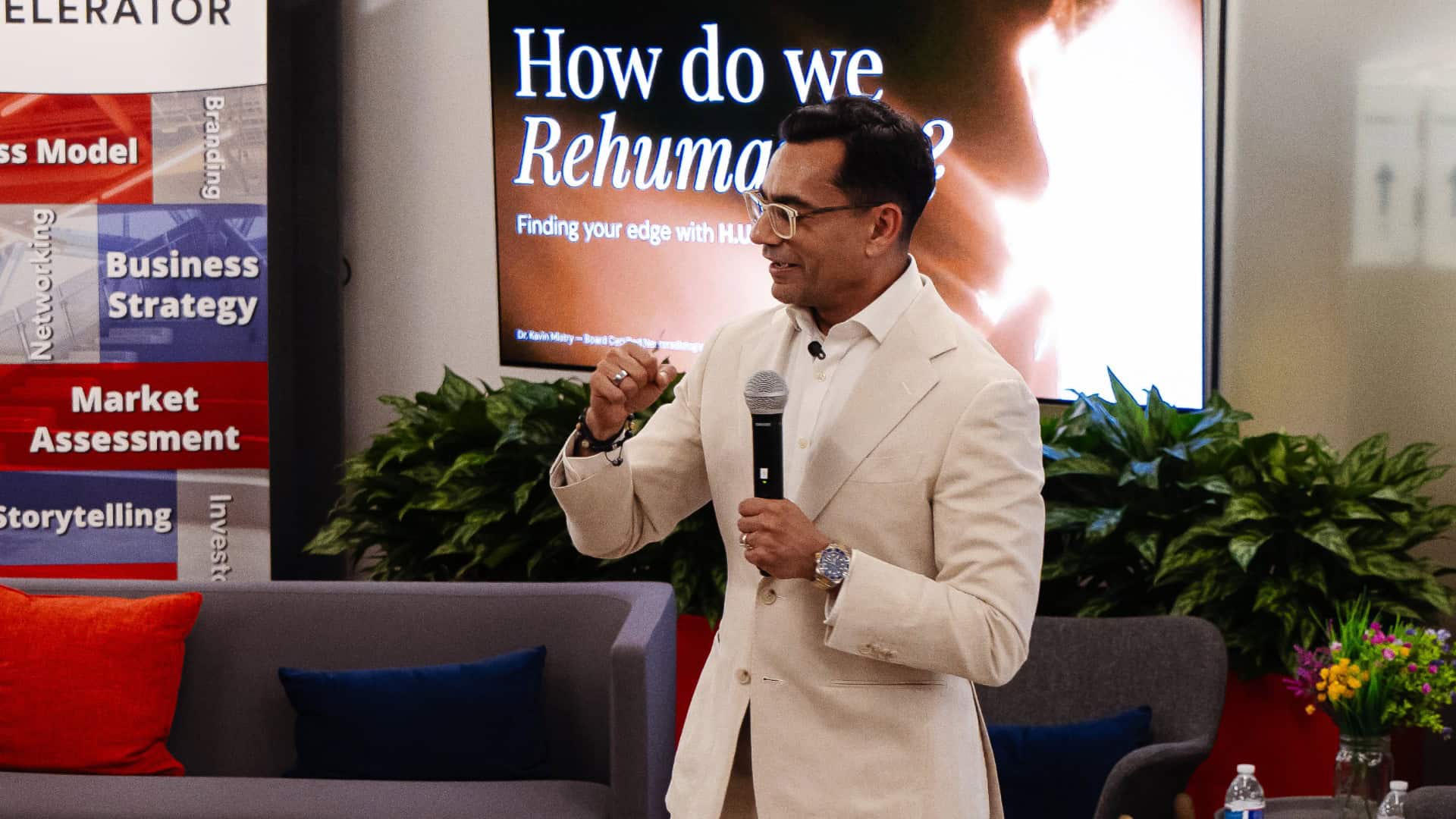
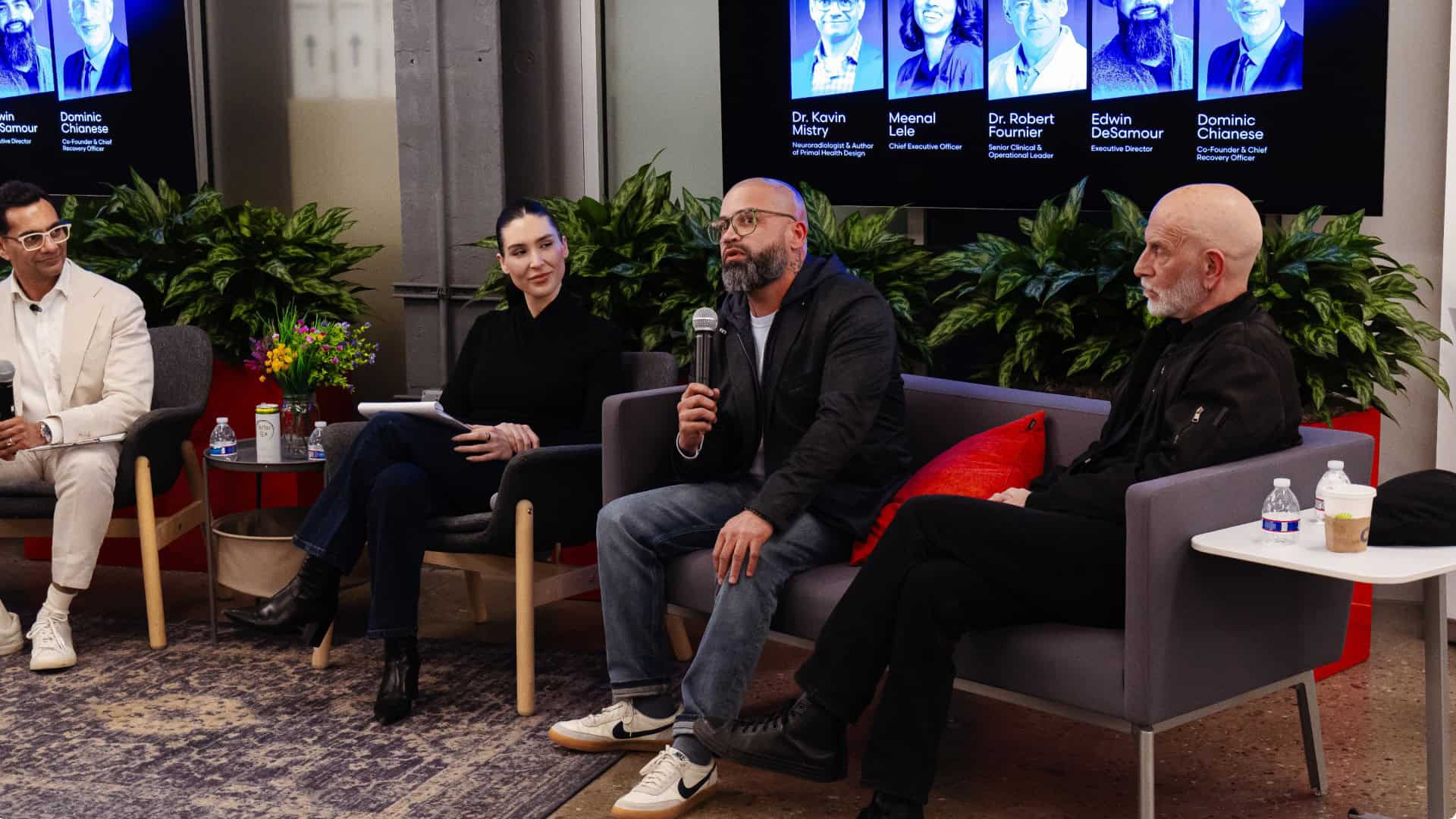
I recently spoke about this at the Philly AI Connect event in Philadelphia’s Pennovation Center, where leaders building the future of artificial intelligence gathered to explore the human side of technological acceleration. My work focuses on what I call Primal Intelligence: the biological and cognitive capacities that allow humans to think clearly, lead effectively, and create meaning in a world increasingly shaped by AI.
Because the real challenge of the age of AI is not technological progress. It is human development.
While AI systems scale intelligence and automation, many people are losing the very capacities that drive meaningful innovation: presence, focused attention, purpose, and connection.
To thrive in the age of AI, we must strengthen what technology cannot replace.
That idea is the foundation of the HUMAN framework.
What the Age of AI Really Means for Humans
When people talk about the age of AI, most conversations focus on technology.
We hear about machine learning models, automation, and predictions about the future of work. But the deeper issue is not technological.
It is human.
Over the past decade I have studied a simple question that became personal to me as a physician:
What makes human beings valuable in a world where machines are becoming more intelligent?
The answer has little to do with speed or efficiency. Technology will always improve in those areas.
The real human advantage comes from qualities machines cannot replicate:
- Presence
- Focused attention
- Meaningful purpose
- Human connection
- Long-term vision
These capacities form the foundation of the HUMAN framework.
The Cognitive Cost of the Digital Era
One of the reasons this conversation matters so much right now is that we are already seeing the biological consequences of the digital environment we’ve created.
Burnout, distraction, and cognitive fatigue are becoming defining challenges of modern life.
The World Health Organization (WHO) now classifies burnout as an occupational phenomenon, recognizing that chronic workplace stress can significantly affect physical and mental health.
At the same time, researchers are documenting dramatic changes in how we process information. Studies suggest that the average human attention span has dropped nearly 50% over the past two decades, reflecting the constant interruptions and information overload of the digital age.
These trends are not just personal challenges. They are leadership challenges.
Leaders today are not simply managing projects or teams. Increasingly, they are managing human cognition in environments where attention is fragmented, information is overwhelming, and burnout is increasingly common.
This is why conversations about artificial intelligence cannot focus only on technology.
In the age of AI, we also need to focus on the biology of attention, resilience, and human performance.
Because if we want humans to guide intelligent machines, we first need to ensure that human minds remain clear, focused, and capable of deep thinking.
Can AI Replace Humans?
This is one of the most common questions people ask in the age of AI.
As artificial intelligence systems become more powerful, many people wonder whether machines will eventually replace human roles across industries.
The short answer is no, but the nature of human value is evolving.
Artificial intelligence excels at processing large datasets, identifying patterns, and generating outputs quickly. In many professions it will dramatically improve efficiency and automate routine tasks.
But AI does not possess the deeper qualities that define human leadership and judgment. Technology can assist with information.
But it cannot replace presence, empathy, context, intuition, and purpose.
I experienced this firsthand about a decade ago when AI systems began outperforming radiologists in detecting patterns on medical images. At first it seemed possible that machines might eventually replace physicians in fields like mine.
But something interesting happened.
The value of human expertise did not disappear. Instead, it evolved.
Patients still needed a physician who could understand context, communicate uncertainty, and guide decisions during difficult moments.
Technology could process data.
But it could not replace human trust.
That experience shaped how I think about the future of work.
AI will not replace humans.
But it will replace humans who disconnect from their humanity.
The HUMAN Framework for Thriving in the Age of AI
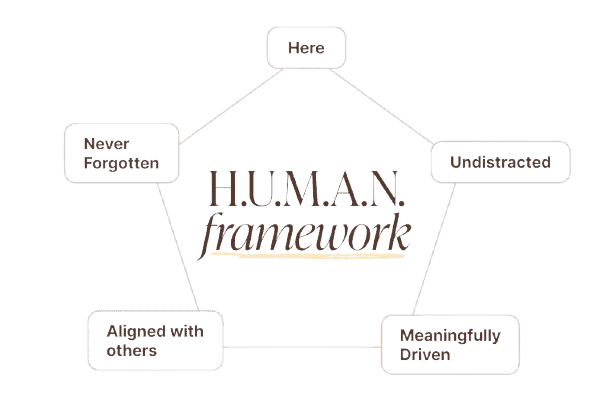
Over the years I began noticing patterns among individuals who remained deeply valuable even as technology advanced.
They shared five qualities that allowed them to think clearly, lead effectively, and collaborate meaningfully.
I organized these into the HUMAN framework:
- Here
- Undistracted
- Meaningful Drive
- Alliances
- Never Forgotten
These are not soft skills.
They are survival skills in the age of AI.
(H)ere: The Power of Presence
Presence is the ability to be fully here.
In a world filled with digital interruptions and endless scrolling, genuine presence has become rare. Yet from a neurological perspective, presence allows the brain to access deeper cognitive networks responsible for creativity, insight, and emotional intelligence.
(U)ndistracted: Protecting Human Attention
If presence is the foundation, focus is the amplifier.
Artificial intelligence can generate enormous amounts of information, but insight still requires sustained attention.
Modern environments constantly fragment our focus. Notifications, messages, and digital platforms compete for attention every minute.
Individuals who learn to protect their attention will develop the clarity and depth required to innovate.
Attention is not just productivity.
It is the gateway to insight.
(M)eaningful Drive
Technology can automate tasks, but it cannot create purpose.
Meaningful drive emerges when people connect their talents with work that contributes something meaningful to others.
When that alignment exists, motivation becomes intrinsic and sustainable.
People driven by meaning do not simply complete assignments.
They pursue missions.
(A)lliances
Innovation rarely happens in isolation.
Breakthrough ideas emerge when people collaborate, challenge each other, and build trust over time.
AI may accelerate productivity, but human relationships remain the foundation of innovation.
Strong alliances allow knowledge to flow and ideas to evolve.
(N)ever Forgotten
The final dimension of the HUMAN framework focuses on legacy.
People who create lasting impact think beyond immediate results. They build ideas, systems, and communities that outlast their individual careers.
In the age of AI, long-term thinking and ethical leadership become increasingly important.
Where Do You Stand in the Age of AI?
After my keynote at the Philly AI Connect event, several people asked how they could evaluate their own alignment with these principles.
Understanding a framework intellectually is one thing. Living it is another.
To help people explore that question, I created the Primal Alignment Index™, a short assessment designed to evaluate how aligned your daily environment and habits are with the biological conditions that allow humans to thrive.
The assessment examines attention, energy, purpose, relationships, and alignment with natural rhythms. If you are curious where you currently stand, take the Primal Alignment Index.
Many people discover something surprising.
Burnout and distraction are often not personal failures. They are signs of environmental misalignment. And awareness is the first step toward realignment.
The Future Belongs to Aligned Humans
The age of AI is not a competition between humans and machines.
Instead, it is an invitation to rediscover what makes us uniquely human.
Presence allows us to connect deeply.
Focus enables clear thinking.
Purpose gives direction to our work.
Alliances allow collaboration and innovation.
Legacy reminds us to build responsibly for the future.
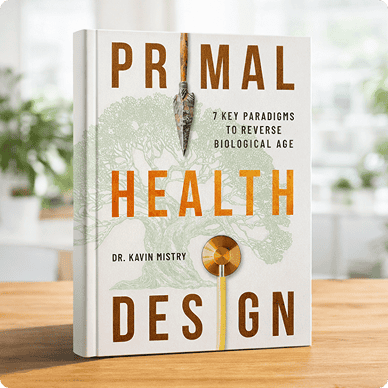
If you want to explore these ideas further and learn how to align your biology, attention, and purpose with how humans are designed to thrive, you can begin with the work I’ve developed in Primal Health Design.
Technology will continue to accelerate.
The question is whether we will strengthen our humanity fast enough to guide it. Because the future will not belong to the fastest machines.
It will belong to the most aligned humans.
— Dr. Kavin Mistry, M.D
FAQ
Q. How long has AI been around?
A: Artificial intelligence as a research field began in the 1950s when scientists first explored whether computers could simulate human reasoning. Advances in computing power and machine learning eventually transformed those early ideas into the powerful AI systems used today.
Q: Why is presence important in the age of AI?
A: Presence improves cognitive clarity, emotional regulation, and decision making. In environments saturated with information and automation, the ability to remain attentive allows humans to interpret complexity and guide technology responsibly.
Q: What human skills matter most in the age of AI?
A: Focused attention, creativity, ethical reasoning, collaboration, and purpose-driven leadership remain essential human skills. These qualities allow individuals to guide artificial intelligence systems rather than compete with them.
Q: Can AI replace human intelligence?
A: Artificial intelligence can automate tasks and analyze large datasets, but it cannot replicate human consciousness, emotional intelligence, or meaning-driven decision making. Humans remain essential for leadership, interpretation, and innovation.