Your purpose is not a single fixed answer you discover once. It is a direction that emerges when your actions, values, and environment align consistently over time.
Key Takeaways
- Purpose is built through alignment, not found through one moment
- Success and community alone do not create meaning
- Your biology responds differently when life feels meaningful
- A deeper, and the last layer of the H.U.M.A.N. framework determines long-term fulfillment
Why the Question “What Is My Purpose?” Keeps Coming Back
Many people reach a point in life where they begin asking, “what is my purpose?” This question often does not arise during failure, but after achieving stability, success, or even strong relationships.
You may have a good career, a structured routine, and a supportive community, yet still experience a persistent sense that something is missing. This is not a lack of discipline or motivation. It is often a signal that direction and meaning have not fully aligned.
Over time, that feeling becomes harder to ignore. It starts to surface in quieter moments, when the noise of daily life settles. You may begin to question what all of your effort is actually building toward, or whether the path you are on truly reflects who you are becoming.
Closely related questions begin to surface:
- What is the point of life?
- What should I do with my life?
These are not separate questions. They are different expressions of the same underlying search for meaning.
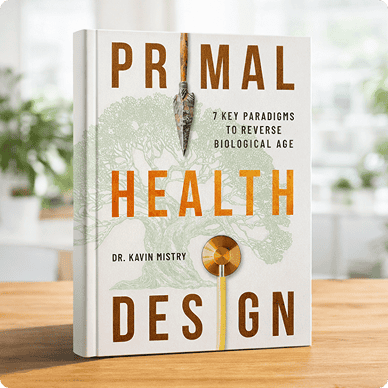
As I wrote in Primal Health Design:
“As we embark on the journey to find your ikigai, remember that purpose is not about discovering a single grand life mission but about engaging with what resonates deeply within you. Let us embrace the roles we were born to play, leveraging them to build thriving communities and foster a life of both personal and collective significance.”
- Dr. Kavin Mistry, Primal Health Design
This reframes purpose in a more grounded way. It is not something you discover once and then hold onto. It is something you build through the way you live, the choices you make, and what you consistently return to over time.
Why Success and Community Still Leave You Searching
Success and community are essential parts of a meaningful life, but they answer different human needs.
Success provides progress and achievement. Community provides belonging and connection. Both matter deeply, yet many people still reach a point where they quietly wonder, Is this all there is?
The missing piece is not another accomplishment. It is having a reason that connects today’s choices to something larger than today itself.
| Human Need | What It Provides | What It Doesn't Fully Answer |
|---|---|---|
| Success | Achievement, progress, recognition | Why your work ultimately matters |
| Community | Belonging, support, connection | The unique contribution only you can make |
| Cause | Meaning, direction, legacy | The work of living it every day |
Purpose isn’t simply about feeling fulfilled.
It’s about knowing that your life is contributing to something that continues beyond the next promotion, achievement, or milestone.
Looking Beyond Success: What Gives Life Meaning?
When people ask, “What is my purpose?”, they’re often searching for the right career, passion, or calling.
But beneath that question is an even deeper one:
What kind of life will matter when I’m no longer here?
This is where the ancient Stoic practice of memento mori, or “remember that you must die,” offers a powerful perspective. It isn’t meant to make us fearful. It reminds us that our time is finite, encouraging us to focus less on what is urgent and more on what is truly important.
When we live with an awareness of our mortality, our priorities naturally begin to shift. We become less concerned with external validation and more intentional about the relationships we nurture, the values we embody, and the impact we leave through our daily actions.
In Primal Health Design, I describe this as a daily practice rather than a philosophical exercise:
Morning Rituals: Embracing Mortality with Awareness Memento Mori Meditation: Start your day by contemplating the impermanence of life. Reflect on the fact that today is a gift and that awareness should guide your actions, choices, and priorities. This will clarify and sharpen your focus on what truly matters.
Daily Legacy Check-In: Before diving into the day's tasks, ask yourself: If today were my last, what would I do differently? Align your actions with what you want to leave behind.- Dr. Kavin Mistry, Primal Health Design
Purpose is not simply about finding work that excites you. It is about living each day in a way that reflects the person you want to become and the impact you hope to have on others. When you begin measuring your life by contribution instead of achievement alone, purpose becomes less about finding the perfect answer and more about living with greater intention.
→ Watch this Mind of Mistry Podcast, where I have Nick Hutchinson, the CEO of BookThinkers, have a discussion on this same topic. | Read the blog
The HUMAN Framework: Living So You're Never Forgotten
Within the PrimAI H.U.M.A.N. Framework, the final pillar is Never Forgotten.
It is built on a simple but powerful idea:
Purpose reduces anxiety because it gives your life direction beyond yourself.
Living with an awareness of your legacy doesn’t mean chasing recognition or hoping people remember your name. It means recognizing that every conversation, every act of service, every relationship, and every decision leaves an imprint on the people around you.
Whether you’re raising children, mentoring a colleague or the youth, caring for a loved one, building a business, or serving your community, your daily actions become part of someone else’s story.
This changes the question from:
“What do I want from life?”
to:
“What am I giving through my life?”
That shift is where meaning begins.
It encourages courage over comfort, contribution over comparison, and long-term thinking over short-term validation.
As AI continues to optimize efficiency, our humanity becomes even more valuable. Technology can automate tasks, but it cannot replace character, compassion, or the legacy we leave through how we live.
Why Purpose Is Biological, Not Just Philosophical
Although purpose often feels like a philosophical question, it also has measurable effects on the brain and body.
Your nervous system is constantly asking whether your daily effort has meaning. When your actions feel disconnected from a larger purpose, stress is more likely to feel draining and adversity more difficult to navigate.
When your life is connected to a meaningful cause, challenges are often experienced differently. Difficult moments become part of a larger story rather than isolated obstacles.
Research supports this connection. Studies from Harvard Health Publishing suggest that having a strong sense of purpose is associated with healthier aging and greater overall well-being. Likewise, research from the National Institutes of Health (NIH) has linked a greater sense of purpose with lower mortality risk and better long-term health outcomes.
Purpose is more than an inspiring idea.
It becomes a biological signal that influences how we respond to stress, maintain resilience, and navigate the inevitable challenges of life.
Start Living With Greater Alignment
Most people try to answer the question, “What is my purpose?” by looking for a single breakthrough moment.
A better place to begin is by looking at your daily life.
Ask yourself:
- Do my daily actions reflect what matters most to me?
- Am I spending my time on things that will still matter a year from now? Five years from now?
- If someone learned how to live by watching me, what would they learn?
Purpose is rarely discovered all at once.
More often, it is revealed through repeated choices that align your actions with your values.
One practical place to begin is by measuring where your life is already aligned and where it may be drifting.
The Primal Alignment Index™ was designed to help you identify those patterns and reconnect your daily life with what matters most.
About the Author
Dr. Kavin Mistry is a board-certified neuroradiologist, educator, speaker, and author of Primal Health Design, creator of the Primal Reset Program and BreathSpan™. His work bridges neuroscience, longevity science, and ancestral wisdom to help people improve healthspan, resilience, and human performance through evidence-informed daily practices.
Learn more about Dr. Mistry → | Follow on LinkedIn, Instagram, YouTube, and Facebook

The neuroradiologist designing human durability,
FAQ
Q. What is my purpose in life?
A: Your purpose in life is not a single role, career, or achievement. It is the ongoing alignment between your values, daily actions, and the contribution you make to others. Rather than something you discover overnight, purpose becomes clearer through intentional living and consistent reflection.
Q. What if I don’t know my purpose?
A: You’re not alone. Dr. Mistry recommends small daily rituals and body-mind practices to help you discover it from within.
Q. How do I define purpose for myself?
A: Start by asking yourself what gives your life meaning beyond personal success. Consider the people you want to impact, the values you want to embody, and the legacy you hope to leave. In Primal Health Design, Dr. Kavin Mistry encourages using daily reflection and alignment practices to help clarify these priorities over time.
Q. How do I answer "What is my purpose?"
A: Instead of searching for one perfect answer, begin by asking better questions. What kind of person are you becoming? What matters most to you? How do your daily actions reflect your values? Purpose is often revealed through the way you live, not through a single moment of discovery.
Q. What are the four pillars of a meaningful life?
A: While many philosophies define life’s purpose differently, Dr. Kavin Mistry’s approach to healthspan emphasizes four interconnected dimensions of well-being: physical health, mental health, emotional health, and existential health. Together, these domains support a life of vitality, connection, resilience, and meaning, rather than focusing on achievement alone.
Q. How is purpose connected to health?
A: Purpose is more than a philosophical idea. Research suggests that having a strong sense of purpose is associated with better emotional well-being, healthier aging, and greater resilience during stress. When daily actions are connected to something meaningful, the brain and nervous system may respond differently to life’s challenges, supporting long-term health and overall well-being.