BreathSpan™: The Hidden Metric of Longevity
Key Takeaways
Shallow breathing may be a sign that your nervous system is spending too much time in stress mode.
BreathSpan™ is a framework for understanding breathing efficiency as a hidden marker of nervous system health, resilience, and longevity.
The way you breathe may influence focus, emotional regulation, recovery, heart rate variability, and stress adaptation.
Breath is not only a respiratory function. It is one of the most direct pathways into the brain and nervous system.
Why Do I Crash So Hard at 2PM?
Every few months, a new health trend appears online.
A biological age calculator. A longevity score. A wearable promising to tell you whether you are aging well. Or a random breath test claiming to reveal the hidden truth about your body.
I understand why these tools are appealing. We want direct signals with helpful feedback. We want to know whether the choices we make today are helping us build strength and vitality for the future.
But after decades of studying the human brain and body as a neuroradiologist, I have come back to a much simpler question.
Most people measure life in years. Modern medicine measures it in biomarkers. But what if longevity wasn’t measured in years at all? What if it was measured in breaths?
Not inside an app. Not behind an expensive test. Not hidden in a complicated dashboard.
Your breath.
You breathe thousands of times a day, yet most people rarely notice how they breathe. They notice their sleep score, their step count, their calories, their glucose, and their heart rate. But the rhythm that quietly shapes their nervous system all day long often goes ignored.
That rhythm may matter more than we realize.
I call this concept BreathSpan™.
BreathSpan™ starts with a simple observation: the way we breathe often reflects the state of the entire human system. When the nervous system is resilient, breathing tends to be calmer and more efficient. When the system is overwhelmed, the breath often reveals it long before we recognize it ourselves.
The Forgotten Metric of Human Longevity
Long before modern neuroscience existed, ancient wisdom traditions explored the relationship between breath and life.
In the Indian tradition, the concept of prana, often translated as life force, suggests that breath is far more than a mechanical process. Breath was viewed as the energetic bridge between body, mind, and consciousness.
Ancient teachings proposed a fascinating idea:
Life is measured not by years, but by breaths.
The slower and more efficiently one breathes, the longer and healthier one may live. At first glance, this idea may sound philosophical or even mystical. Yet modern science is beginning to uncover physiological mechanisms that make this concept surprisingly relevant.
The average adult takes approximately 17,000 to 30,000 breaths each day. Experienced meditators, elite endurance athletes, and many long-lived populations often demonstrate significantly lower resting respiratory rates than the general population.
This observation does not mean we should obsess over counting breaths. It means breathing efficiency may be telling us something important about the state of the entire human system.
This insight became the foundation of BreathSpan™.
Not as a breathing technique. Not as another health hack.
But as a framework for understanding how breathing influences attention, resilience, human performance, nervous system health, and longevity.
Why I Created the BreathSpan™ Framework
Over the course of my career, I have interpreted more than 300,000 brain and body imaging studies. Day after day, I have had the opportunity to observe the extraordinary complexity of the human body and the remarkable ways in which our choices influence long-term health.
What fascinated me was not simply the presence of disease.
It was the absence of it.
Why do some people remain mentally sharp, physically capable, emotionally resilient, and deeply engaged with life well into later decades, while others seem to decline much earlier?
The answer was rarely found in a single laboratory value or imaging study. Instead, it often reflected patterns.
- Patterns of stress.
- Patterns of recovery.
- Patterns of movement.
- Patterns of attention.
- Patterns of connection.
Over time, I became increasingly interested in creating practical frameworks that help people understand these patterns and apply them to their own lives.
In a world saturated with conflicting health advice, optimization trends, and quick fixes, many people are searching for a signal amid the noise.
My goal has never been to create another health hack.
My goal has been to translate neuroscience, longevity science, and human performance research into practical principles that people can actually live by.
BreathSpan™ emerged from that work.
The more I studied longevity, nervous system regulation, cognitive performance, and healthy aging, the more convinced I became that breathing efficiency was not simply a reflection of health.
It was often a reflection of how efficiently the entire human system was functioning.
Which raises an important question:
If breathing efficiency can tell us so much about the state of the body and brain, what happens when that breathing pattern becomes inefficient?
For millions of people, that pattern often takes the form of shallow breathing.
What Is Shallow Breathing?
Shallow breathing typically refers to a breathing pattern characterized by short, rapid breaths that rely heavily on the upper chest rather than the diaphragm.
Most people breathe this way without even realizing it. All of the below can contribute to inefficient breathing patterns:
Stress
Poor posture
Long hours at a desk
Excessive screen time
Sleep disruption
Chronic anxiety
When breathing becomes consistently rapid, restricted, or inefficient, the body may interpret those signals as evidence that a threat exists.
Over time, the body can become trapped in a state of physiological vigilance, remaining prepared for danger even when no immediate danger is present.
This is why breathing patterns matter.
What Does Shallow Breathing Indicate?
Shallow breathing may indicate that the body is spending too much time in sympathetic activation, the branch of the autonomic nervous system associated with fight-or-flight. In modern life, this pattern is common because the nervous system is repeatedly activated by deadlines, notifications, artificial light, financial pressure, poor sleep, chronic uncertainty, and information overload.
For many people, shallow breathing is less about the lungs and more about the state of the nervous system. It may reflect chronic stress, anxiety, poor posture, mouth breathing, insufficient movement, poor sleep, or a persistent fight-or-flight response.
In today’s environment, these factors are increasingly common.
Financial pressure.
Information overload.
Social media.
The body responds to these inputs biologically, and one of the earliest places that response often appears is in the breath. In some cases, shallow breathing may also be related to medical conditions involving the lungs, heart, nervous system, muscles, or blood oxygen levels.
Persistent shortness of breath, chest pain, dizziness, confusion, or breathing difficulty should always be evaluated by a qualified healthcare professional.
Every Thought Changes the Breath. Every Breath Changes the Brain.
Most people think of breathing as a mechanical process that delivers oxygen to the body. That is true, but incomplete. Breathing is also a communication channel between the brain and the body.
When we experience anxiety, our breath changes. When we feel anger, our breath changes. When we feel grief, fear, focus, or calm, our breath changes. Every emotional state leaves a fingerprint on the respiratory system. What is equally important is that this relationship works in reverse. By changing the breath, we may influence the brain networks involved in attention, emotional regulation, stress response, memory, and decision-making.
This is why breath has been central to contemplative traditions for thousands of years. It is also why modern neuroscience continues to study breathing as a tool for regulating physiology. The breath is not merely a survival mechanism. It may be one of the most direct pathways we have for changing the state of the brain.
The Neuroscience of BreathSpan™
To understand BreathSpan™, we must first understand the autonomic nervous system.
The autonomic nervous system regulates countless functions that occur beneath conscious awareness, including heart rate, blood pressure, digestion, immune activity, hormone production, recovery, and emotional regulation.
It consists of two primary branches.
The sympathetic nervous system prepares the body for action.
- Heart rate increases
- Blood pressure rises
- Stress hormones are released
- Attention narrows
- Energy is mobilized toward survival
This response is essential when genuine threats are present.
The parasympathetic nervous system serves the opposite role.
It promotes:
- Recovery
- Healing
- Digestion
- Immune regulation
- Restoration
- Emotional stability
The challenge is that modern life continuously stimulates the sympathetic system.
Many people are not experiencing occasional stress.
They are experiencing chronic activation.
One of the earliest physiological signs of this state is a change in breathing.
- Respiratory rate increases
- Breaths become shorter
- Breaths become shallower
The body begins preparing for threats that may never arrive.
The average adult breathes approximately 12 to 20 times per minute. Yet experienced meditators, elite endurance athletes, and many centenarians often breathe at rates closer to 6 to 10 breaths per minute. This is not simply a breathing difference. It is a nervous system difference. A slower respiratory rate often reflects greater physiological efficiency, stronger parasympathetic activity, and a more adaptable response to stress.
In many ways, BreathSpan™ is where longevity meets the nervous system.
The Vagus Nerve: A Hidden Link Between Breathing and Longevity
At the center of this conversation sits one remarkable structure: the vagus nerve.
The vagus nerve is one of the most important regulators of the parasympathetic nervous system, the body’s built-in recovery system. It serves as a communication network between the brain and many of our most vital organs, helping coordinate heart rate, breathing, digestion, immune function, and emotional regulation.
In many ways, the vagus nerve helps determine how effectively we can transition from stress to recovery, from vigilance to calm, and from survival to healing.
When breathing slows, particularly when exhalation is prolonged, vagal activity tends to increase. This produces measurable physiological changes:
- Lower heart rate
- Increased heart rate variability
- Reduced cortisol production
- Improved emotional regulation
- Reduced inflammation
- Enhanced resilience to stress
- Greater cognitive flexibility
Research increasingly suggests that slow, controlled breathing may improve autonomic balance and vagal tone, helping individuals become more adaptable in the face of stress.
This is why breathing is so powerful. It gives us access to a system that normally runs beneath conscious awareness. We cannot directly tell the vagus nerve to activate, but we can use the breath to send signals of safety.
A calmer breath often reflects a calmer system.
And a calmer system may be better equipped to recover, focus, regulate emotion, and age with greater resilience.
Why Breathing Shapes Attention
Attention has become one of the most valuable resources of the modern age.
Yet for many people, it feels increasingly difficult to sustain.
Notifications interrupt us. Screens compete for our focus. Multitasking has become a default mode of operation. Many people spend their days feeling mentally scattered, reactive, and unable to fully engage with the task in front of them.
Most attempts to improve attention focus on productivity systems, apps, supplements, or time-management strategies. While these tools can be helpful, they often overlook a more fundamental question:
What if attention is not just a cognitive problem, but a physiological one?
Modern neuroscience suggests that respiration influences neural activity within brain networks responsible for attention and executive function. Breathing rhythms help synchronize neural oscillations throughout the brain, acting almost like a metronome for cognition. When breathing becomes erratic, attention often follows. When breathing becomes calm and rhythmic, the brain is more likely to enter states of focus, clarity, and presence.
This may help explain why elite performers across disciplines often train their breathing intentionally. Athletes, military operators, musicians, meditators, and high-performing leaders all understand that attention is not simply something we think our way into. It is something we regulate through the body.
The BreathSpan™ framework recognizes that one of the fastest ways to reclaim attention is to first reclaim breathing. Before we can consistently improve focus, we must create the physiological conditions that allow focus to emerge. The breath provides one of the most direct pathways for doing exactly that.
In many ways, attention follows physiology. And physiology follows the breath.
"The BreathSpan™ Framework recognizes that one of the fastest ways to reclaim attention is to first reclaim breathing."
- Dr. Kavin Mistry
How Primal Health Design Expands Your BreathSpan™
One of the most important realizations behind BreathSpan™ is that breathing efficiency rarely improves in isolation. It improves when the entire human system becomes more aligned.
This is why BreathSpan™ is deeply connected to the seven paradigms of Primal Health Design.
Every paradigm ultimately influences the nervous system. And the nervous system ultimately influences the breath.
Earth
Time in nature has been associated with reduced stress physiology, improved emotional regulation, and calmer breathing patterns.
Body
Movement improves respiratory efficiency, oxygen utilization, and metabolic health.
Food
Whole-food nutrition reduces inflammation and metabolic stress, allowing the body to function more efficiently.
Mind
Meditation and mindfulness practices have repeatedly been shown to influence respiratory rate and nervous system regulation.
Purpose
Meaning reduces chronic stress and creates psychological resilience.
Community
Connection creates biological safety and supports emotional well-being.
Finiteness
Accepting mortality often reduces resistance, anxiety, and the constant urgency that drives modern stress responses. When these paradigms become more aligned, breathing often becomes slower, calmer, and more efficient.
BreathSpan™ is not simply about the breath. It is about creating a human system capable of breathing well.
A Simple BreathSpan™ Practice
You do not need expensive equipment to begin improving your relationship with your breath. You need awareness, consistency, and a willingness to slow down.
Try this simple practice:
Sit comfortably with your spine tall but relaxed.
Inhale gently through the nose for four seconds.
Exhale slowly through the nose for six seconds.
Continue for five minutes.
Keep the breath quiet and effortless.
The slightly longer exhale helps send a signal of safety to the nervous system. Over time, the heart may become more adaptable, the mind may become quieter, and the body may begin to associate the breath with recovery rather than stress.
The practice is simple, but not small. It teaches the nervous system a new rhythm.
Teaching BreathSpan™ to the Next Generation

One of the most meaningful experiences for me has been bringing these principles beyond adults interested in longevity and into spaces where young people are learning how their brains and bodies work.
This year, I had the opportunity to help lead the Guiding Light STEM Program in partnership with The Lighthouse 1893 and Grayson Sky. The program introduces children ages 8 to 13 to science, technology, engineering, arts, and mathematics through hands-on learning experiences. The 2026 program includes themes such as Body Systems, Brain Science, Movement Lab, Fuel and Focus, and Confidence and Goals.

During the opening weeks, I taught students about the human brain, the nervous system, attention, and the role breathing plays in learning and self-regulation. What struck me most was how quickly children understood the idea that the breath can change the state of the brain.
Before children become innovators, leaders, athletes, artists, or scientists, they benefit from understanding the operating system they carry everywhere: the human brain.
BreathSpan™ is not only about aging well. It is about living well at every age. When children learn how to work with their breath, they are also learning how to work with focus, stress, emotion, and confidence.
→ Check out one of the stellar Lighthouse students talk about our STEM program
Community Reflection
One of the most powerful things about sharing BreathSpan™ publicly has been hearing how people describe their own relationship with breath.
“Breathing is one of the few physiological processes that operates both automatically and voluntarily, giving us a direct pathway to influence stress responses, attention, emotional regulation, and recovery. Simple, but incredibly powerful.”
- One reader shared:
“Learning to work with the breath is a high-leverage skill. Practices like tai chi and qigong have helped me manage stress in ways I never expected.”
- Another reflected
These reflections capture something essential. Breath sits at the intersection of physiology and awareness. It is automatic enough to keep us alive, yet accessible enough to help us change our state.
That is why the breath deserves more attention in conversations about healthspan and longevity.
Breathe Less. Live More.
We live in a culture obsessed with doing more. More output. More content. More stimulation. More data. More optimization.
But health is not always built by adding more. Sometimes it is built by removing noise, slowing the system, and allowing the body to return to rhythm.
Breathing slower is not about doing less with your life. It is about creating the internal conditions to live with greater presence, focus, and meaning.
As I write in my book, Primal Health Design:
“A fulfilled life is not measured in years but in depth. The goal is not merely longevity but presence, impact, and legacy.”
That is the deeper purpose of BreathSpan™. It is not simply a breathing framework. It is a way of remembering that longevity without presence is incomplete.
When we improve the quality of our breathing, we may improve the quality of our attention. When we improve the quality of our attention, we improve the quality of our lives.
And perhaps the simplest way to say it is this:
“A well-lived life has no wasted breath.”
So take a deep breath.
And begin.
Continue Your Journey
Read the Primal Health Design
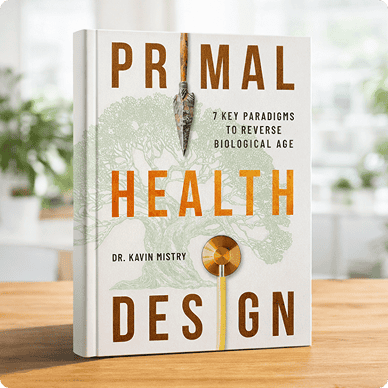
Primal Health Design: 7 Key Paradigms to Reverse Biological Age
In Primal Health Design, I explore the seven foundational connections that shape biological age, vitality, and healthspan: Earth, Body, Food, Mind, Purpose, Community, and Finiteness. These paradigms form the foundation for BreathSpan™ and the larger path toward living with greater resilience, clarity, and meaning.
Join the Primal Reset
The Primal Reset is my guided transformation experience designed to help you reconnect with the daily rituals that shape your energy, focus, nervous system, biological age, and long-term vitality. Through practical implementation, lifestyle redesign, and healthspan-focused rituals, the program helps translate the Primal Health Design framework into daily life.
About Dr. Kavin Mistry M.D.
Dr. Kavin Mistry is a board-certified neuroradiologist, longevity educator, speaker, and author of Primal Health Design: 7 Key Paradigms to Reverse Biological Age.
Throughout his medical career, Dr. Mistry has interpreted more than 300,000 brain and body imaging studies, giving him a unique perspective on the relationship between lifestyle, brain health, biological aging, and human performance.
His work sits at the intersection of neuroscience, longevity science, ancestral wisdom, and human performance. Through his writing, speaking, media appearances, and coaching programs, he helps individuals improve healthspan, resilience, focus, and overall quality of life.
Dr. Mistry is also the creator of BreathSpan™, a framework that explores the relationship between breathing efficiency, nervous system health, human performance, and longevity, and the Primal Alignment Index™, a self-assessment designed to help individuals identify opportunities for greater vitality and alignment across the core paradigms of Primal Health Design.
Learn more:
• YouTube
The neuroradiologist designing human durability
Frequently Asked Questions
Q. How do you know if your breath is shallow?
A: You may be shallow breathing if your chest rises more than your abdomen, if you frequently sigh or yawn, if your neck and shoulders feel tense, or if you often feel like you cannot take a full breath. Other signs may include fatigue, anxiety, mouth breathing, and feeling mentally scattered. A simple way to notice your pattern is to place one hand on your chest and one hand on your lower ribs or abdomen while breathing normally.
Q: Can you reverse shallow breathing?
A: In many cases, shallow breathing patterns can improve over time with consistent practice and lifestyle changes. Breath awareness, stress regulation, posture correction, physical activity, and better sleep rhythms may help retrain the body toward more efficient breathing. If shallow breathing is caused by an underlying medical issue, professional evaluation and treatment may be necessary.
Q: What is BreathSpan™?
A: BreathSpan™ is Dr. Kavin Mistry’s framework for understanding the relationship between breathing efficiency, nervous system regulation, resilience, focus, recovery, and longevity. It is not a single breathing technique. It is a broader way of viewing the breath as a hidden metric of how well the human system is functioning.
References
Laborde S, Allen MS, Borges U, et al. Effects of slow-paced breathing on stress and autonomic function: A systematic review and meta-analysis. Neurosci Biobehav Rev. 2025;171:106030. PMID: 40252198.
External link: https://pubmed.ncbi.nlm.nih.gov/40252198/
Balban MY, Neri E, Kogon MM, et al. Brief structured respiration practices enhance mood and reduce physiological arousal. Cell Reports Medicine. 2023;4(1):100895. PMID: 36630953.
External link: https://pubmed.ncbi.nlm.nih.gov/36630953/
Zaccaro A, Piarulli A, Laurino M, et al. How breath-control can change your life: A systematic review on psychophysiological correlates of slow breathing. Front Hum Neurosci. 2018;12:353. PMID: 30245619.
External link: https://pubmed.ncbi.nlm.nih.gov/30245619/
Lehrer PM, Gevirtz R. Heart rate variability biofeedback: How and why does it work? Front Psychol. 2014;5:756. PMID: 25101026.
External link: https://pubmed.ncbi.nlm.nih.gov/25101026/
Russo MA, Santarelli DM, O’Rourke D. The physiological effects of slow breathing in the healthy human. Breathe. 2017;13(4):298-309. PMID: 29209423.
External link: https://pubmed.ncbi.nlm.nih.gov/29209423/
Kim HG, Cheon EJ, Bai DS, Lee YH, Koo BH. Stress and heart rate variability: A meta-analysis and review of the literature. Psychiatry Investig. 2018;15(3):235-245. PMID: 29486547.
External link: https://pubmed.ncbi.nlm.nih.gov/29486547/
Thayer JF, Lane RD. The role of vagal function in the risk for cardiovascular disease and mortality. Biol Psychol. 2007;74(2):224-242. PMID: 17081672.
External link: https://pubmed.ncbi.nlm.nih.gov/17081672/